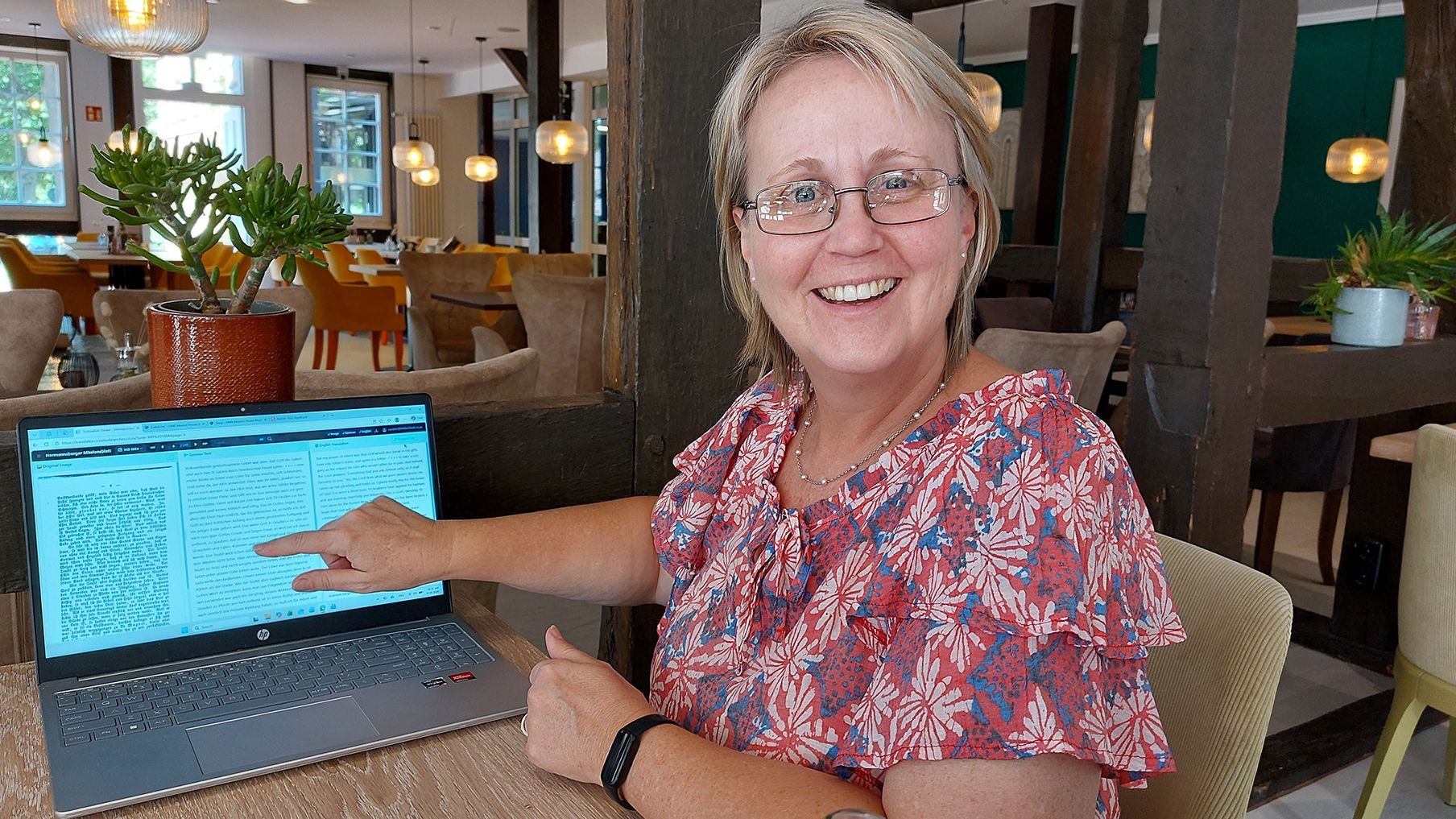
As curator of the Mission House Museum in Hermannsburg, South Africa, Christel Andersen has conducted extensive research into historical mission journals.
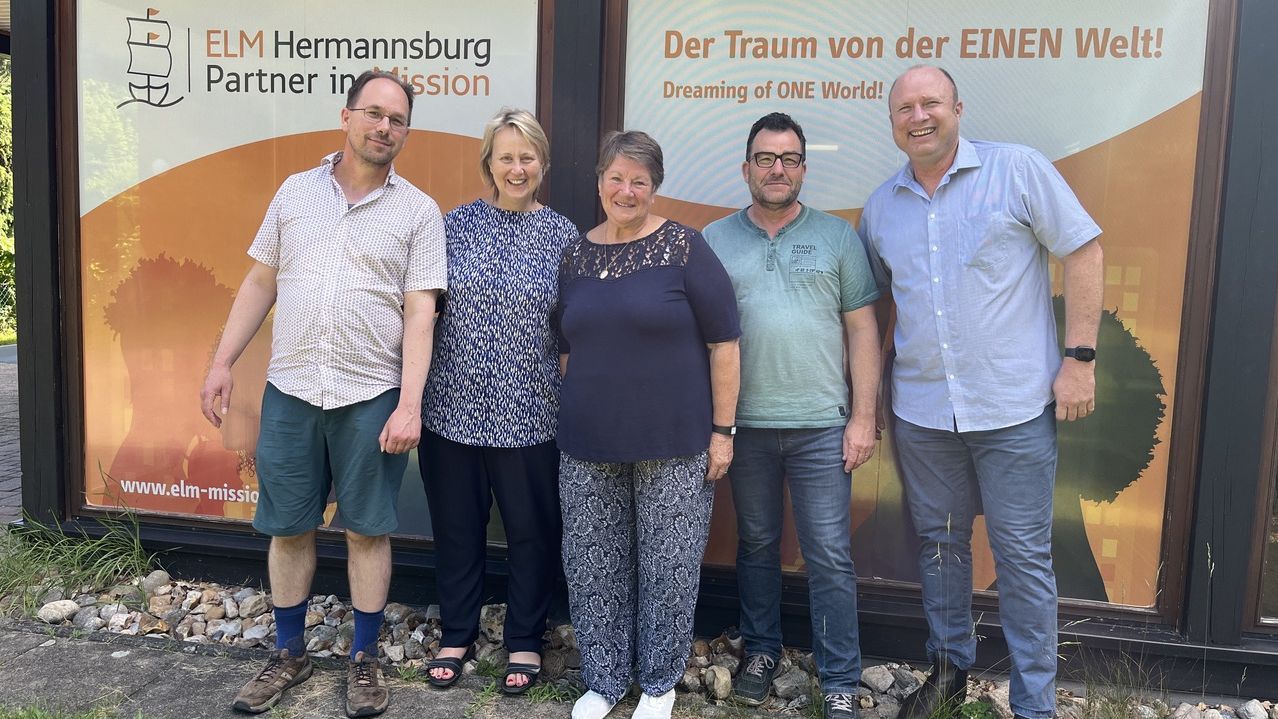
Meeting as part of the project planning for the ‘Digitisation of the Mission Sheets’; (from left) Rainer Allmann, Christel Andersen, Stella Cockburn, Holger Nerlich and Dr Joe Lüdemann in front of the ELM headquarters.
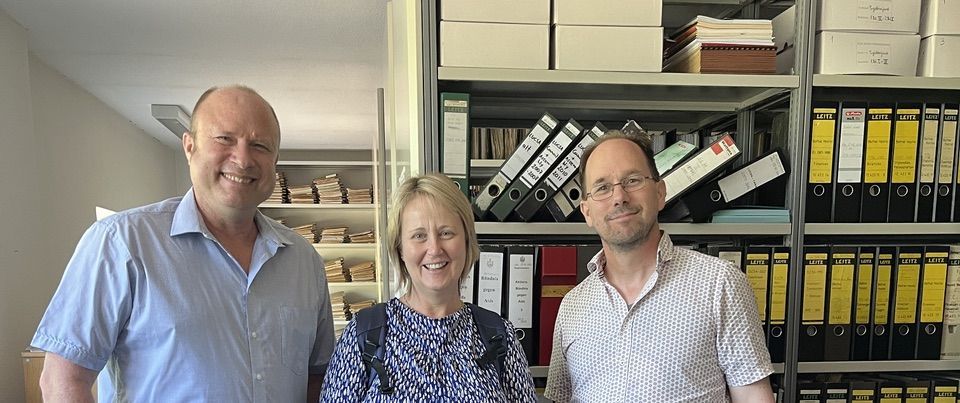
Dr Joe Lüdemann, Christel Andersen and Rainer Allmann (from left) in the ELM archives.
Mission journals as scholarly contributions
“It is a cultural treasure, a missionary treasure and a Christian treasure.”
When she talks about the mission journals, which have been published since 1854, Christel Andersen really does wax lyrical. The director of the Mission House Museum in Hermannsburg, South Africa, enjoys immersing herself in the journals even after work, where the experiences and observations of missionaries sent from Hermannsburg, Germany, have been recorded over the centuries. “It’s more exciting than any TV or Netflix series,” says the South African, whose ancestors travelled from the Südheide to South Africa aboard the mission ship ‘Kandaze’.
The mission journals, which were published monthly until 1974 and then every two months until 1993, served primarily to keep people in the ‘old homeland’ informed about the situation of the Hermannsburg Mission in Africa, Latin America and Asia – and, for a time, Australia as well – and to encourage them to make donations. As the missionaries also reported on the everyday lives of people in these distant lands, as well as on political and social events, the mission journals have a historical value that extends beyond the history of the Church. “There is very little written history from this period in many of these countries,” explains Christel Andersen. For example, readers learnt about the wedding of a Zulu king in South Africa through detailed accounts.
This treasure trove of reports is now to be made available digitally to interested parties, but above all to the academic community. Heinz Küsel from Pretoria, also a descendant of a Hermannsburg missionary family, has purchased a special scanner for this purpose. Using this device, an ‘object recognition scanner’, the texts – most of which are still printed in old German script – can be scanned in such a way that they are captured not just as a single image but as individual words. This enables subsequent translation into various languages as well as searching by keywords. “There are still some technical issues; the system is currently running on a test server,” reports Christel Andersen.
During a visit to Hermannsburg, Germany, in June 2026, she presented the project to the Ev.-luth. Mission in Lower Saxony (ELM). The ELM is providing financial support for the digitisation of the mission journals. In addition, ELM archivist Rainer Allmann is one of the editors tasked with comparing pages that have already been scanned with the originals, thereby identifying areas where the software still needs improvement. There is still a great deal of work ahead for everyone involved: after all, including the successor publications *Mitteilen*, *Mitmachen* and *Mitleben*, there are a good 38,000 pages of mission history that are to be processed and made accessible here in the long term.
