
Lecture with discussion: Mission collections unpacked
How does mission actually get into museums - and what do we do with their collections today?
4 February 2026 in the Ludwig Harms House was all about the history of missions through an examination of mission collections. In the afternoon, people who have been associated with the ELM for many years met to reflect on their own experiences of dealing with objects from the work in different cultural contexts. A visit to the depot of the ELM collection led to a lively exchange with the academics and curators who had travelled from Bochum and Hanover.
The warm-up to the evening event was provided by Dr Patrick Felix Krüger (art and religious studies scholar) and Dr Knut Martin Stünkel (philosopher of religion) with a lecture on research at the Centre for Religious Studies (CERES). Together, the researchers from Ruhr-Universität Bochum proved that the study of missionary collections is still exciting today.
Dr Patrick Felix Krüger, who curates exhibitions in addition to his research, explained the concept of the exhibition "Missionary Collections Unpacked", which will be on display at the Rautenstrauch-Joest-Museum in Cologne from October 2025 to February 2026. One prominent object in the collection is an oil painting of the Hermannsburg mission ship Candace, which can be seen right at the beginning of the exhibition.
In the further course of the lecture, Dr Knut Martin Stünkel emphasised that religions arise from contact with other religions and that this contact is absolutely essential. This always involves a comparison. According to Stünkel, this religious contact can also arise through religious objects or collection items, even between objects.
This thesis was underpinned with examples. One example was a photo of an exhibition showcase in which objects from completely different religions were arranged almost randomly. The question was asked: "What effect does this have on the viewer?" Other examples showed how missionaries tried to create cultural and religious connectivity for Christianity. Traditional Chinese paintings, Hindu oil lamps and house shrines, whose appearance was altered through the use of Christian symbols, were used for this purpose. This was intended to create a certain connectivity.
After this warm-up, Dr Patrick Felix Krüger showed examples of other missionary collections. CERES works together with various Protestant and Catholic missionary organisations.
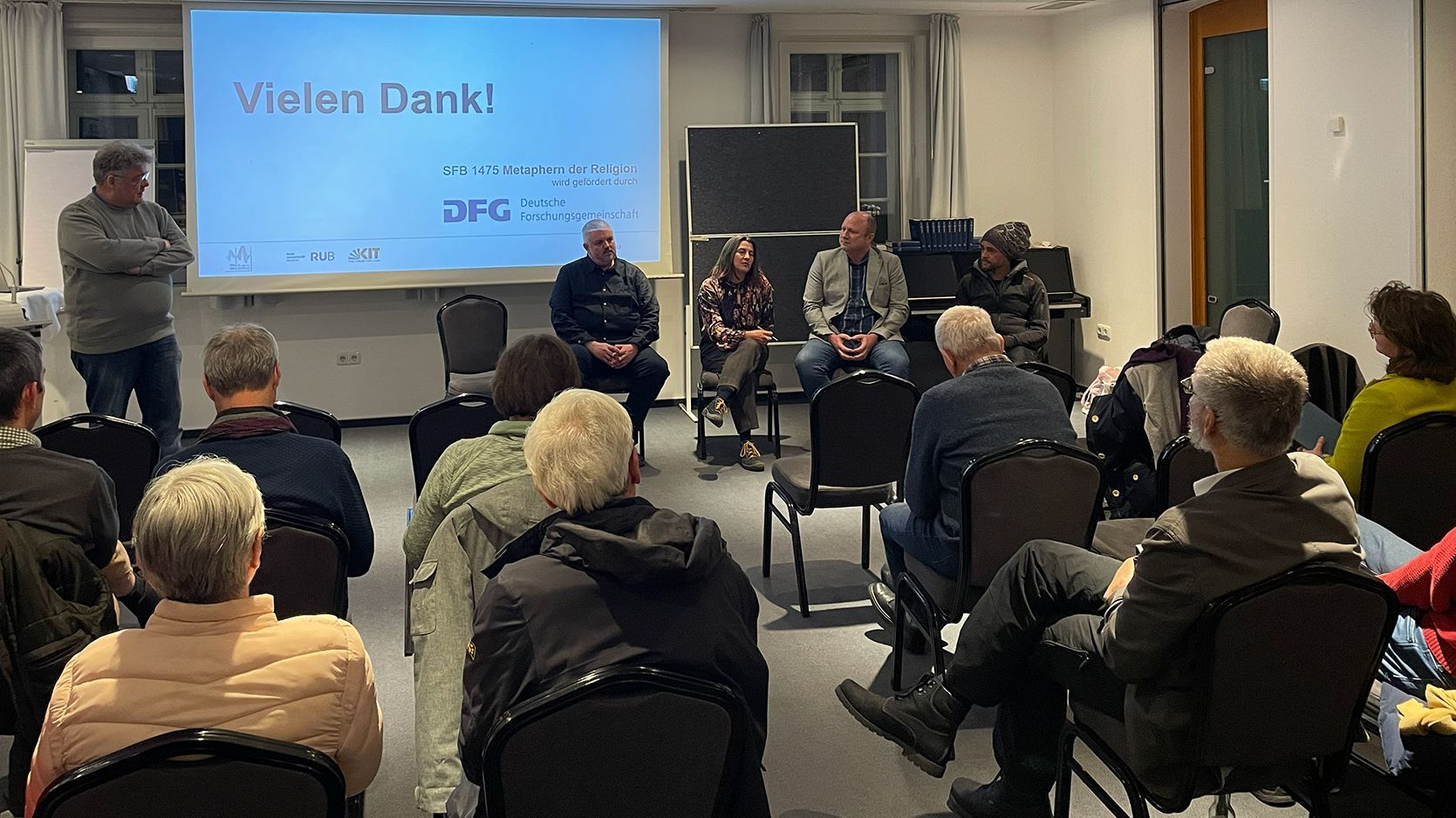
In the subsequent panel discussion entitled
"Religion, Mission & Museum - Between Collecting, Exhibiting and Preserving in the Right Place"
, different perspectives and people entered into dialogue. The following people sat on the panel:
- Art & Religious Studies: Dr Patrick Felix Krüger (Ruhr University Bochum)
- Provenance research: Dr Sebastian Sprute (Landesmuseum Hannover)
- History: Dr Felicity Jensz (Ruhr University Bochum)
- Missionary works: Dr Joe Lüdemann (ELM)
- Moderation: Dr Knut Martin Stünkel (Ruhr University Bochum)
The discussion was opened with a provocative question from the audience: Can 't we (editor's note: the ELM) just throw away the old stuff?
Dr Felicity Jensz replied that the collections help to preserve and contextualise history and are therefore of great value.
The historical context and future generations must also be taken into account. However, it is also clear that missionary collections have lost their original purpose and must now be re-evaluated.
Nevertheless, ownership is an obligation and this is especially true for religious artefacts. On the one hand, this involves questions of acquisition. The keywords here are colonialism, but also the appreciation of other cultures and religions that goes hand in hand with the care of the exhibits. Dr Joe Lüdemann also sees reasons for intercultural dialogue in the objects and therefore considers them to be beneficial for the work of the ELM.
The event, which Ulrich Meyer Höllings described as the beginning of a process in which the collection will be analysed, ended about an hour later than planned. We cordially invite people who have been associated with the ELM for many years to participate in the further development of "our" mission collection. Through the scientific and curatorial support from Bochum and Hanover, we can support an examination of the ELM's missionary history and learn from the past for the future.
This is also demonstrated by the work of Dr Sebastian Sprute from the Hanover State Museum, who is currently researching the objects in the ELM collection every week. Some of the artefacts will also be exhibited in the State Museum in the future.


