


Between violence and hope
When Pastor Joseph Ngoé talks about the situation facing his church, he sounds calm and focused. Almost matter-of-fact. Yet he comes from a country that has been plagued by violence, insecurity and political crises for years: the Central African Republic.
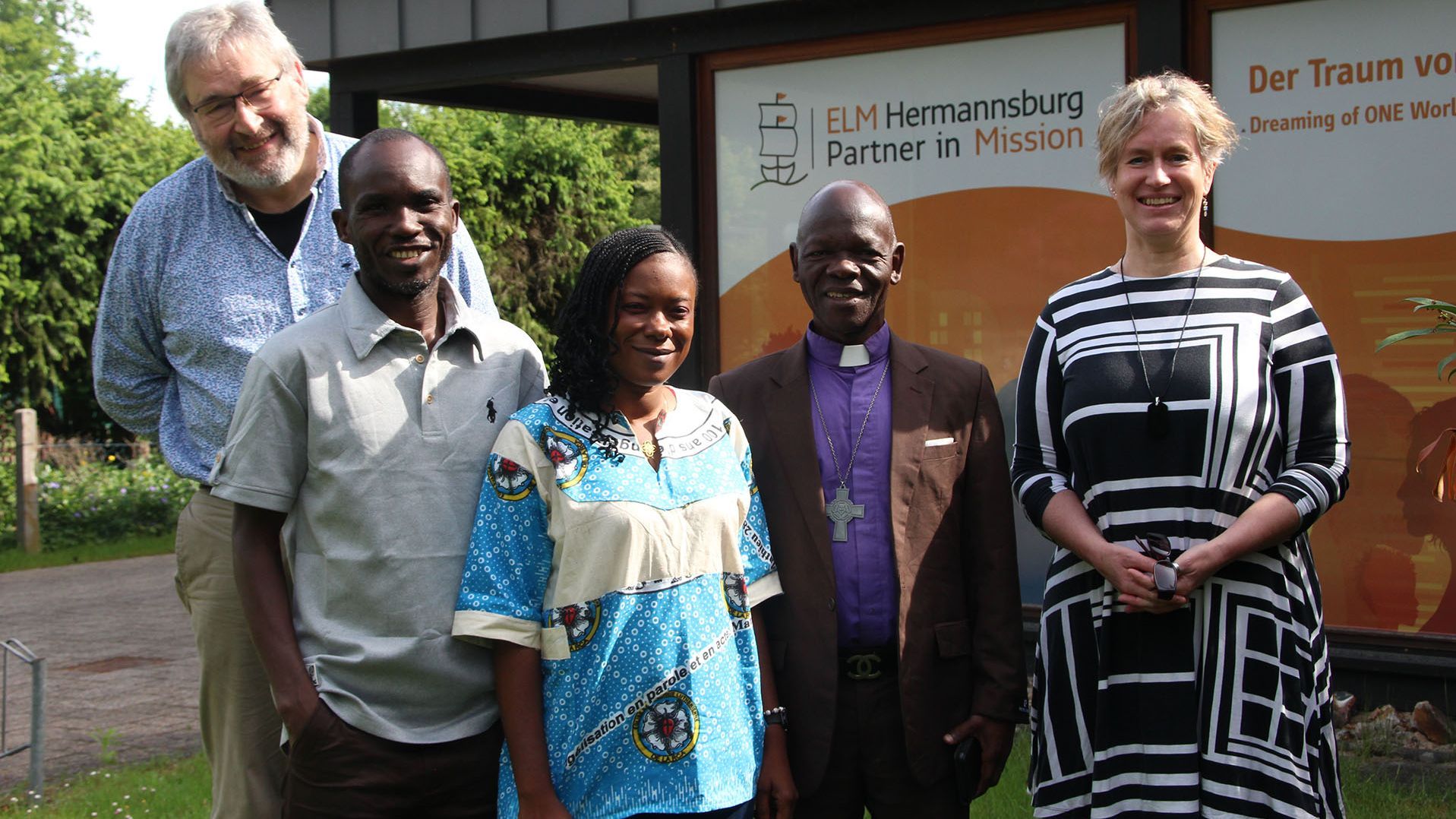
Accompanied by Rock Babou, the church’s finance officer, and Felicité Tazao, head of health care, the president of the Evangelical Lutheran Church in the Central African Republic (EELRCA) visited Germany in May 2026 at the invitation of the Evangelical Lutheran The aim of the trip is to re-evaluate the partnership between the ELM and the EELRCA and to develop shared perspectives.
A country caught between fragile stability and ongoing insecurity
The delegation comes from a country that remains politically fragile despite some progress. Although peace processes in recent years have succeeded in disarming some armed groups, attacks by militias continue, particularly in the east of the country. The government is far from having full control over all regions. International missions from the UN and the EU continue to try to guarantee stability and security.
Ngoé describes the situation without drama. “It is true that there has been a great deal of violence in the country,” he says. “But the scale of the violence has decreased.” The state has now taken on more responsibility, whilst churches and religious communities have also helped to stabilise the situation. Nevertheless, the reality remains difficult. According to the Federal Foreign Office, more than a third of the population is dependent on humanitarian aid, and many people have been displaced by armed conflicts.
This is precisely why Ngoé sees the Church not merely as a spiritual institution, but as a social force. His work as Church president is that of a “shepherd”. People come to him with their worries: financial problems, social conflicts, moral questions. Many have lost hope and trust as a result of the years-long crisis. “Some have wondered whether God even exists,” he says.
The day-to-day life of the church leadership seems surprisingly down-to-earth. The work begins with prayer and Bible reading, followed by administrative tasks, discussions with staff, meetings with government bodies and consultations on projects for women, children and young people. Time and again, the same question arises: how can we achieve as much as possible with limited resources?
Healthcare where the state is barely present
Felicité Tazao, who works in the church’s healthcare sector, describes these challenges in particularly vivid terms. The church runs health centres and hospitals in remote regions of the country – often in places where state healthcare is virtually non-existent. “The importance of our work is immense,” she says. Many people have to walk for miles just to reach medical help at all. Roads are often barely passable, there is a shortage of petrol, and ambulances are old and constantly in need of repair.
The problems start with basic care. There is a shortage of surgical supplies, medicines and nursing equipment. Premature babies often cannot be adequately cared for. Child malnutrition is a massive problem. “Sometimes we can only accompany premature babies until they die,” she says – a sentence that hangs heavily in the air during the conversation.
The situation is particularly dire outside the capital, Bangui. In many regions, armed groups continue to control individual areas or transport routes. The state’s presence there remains weak, and humanitarian aid reaches many places only to a limited extent. This also makes healthcare work more difficult. International reports continue to warn of attacks by armed groups on civilians and medical facilities.
Cooperation as the foundation for the future andöreconciliation
Nevertheless, the delegation does not describe its work as a resigned struggle for survival. Rather, it is striking how strongly the idea of cooperation is emphasised. Rock Barbou, responsible for the church’s finances, repeatedly speaks of transparency and trust. He sees the partnership with the ELM as a “resumption of cooperation hand in hand”.
The relationship between religions also plays an important role in this. The church’s health centres are explicitly open to everyone – regardless of their religion. “Our primary concern is people’s lives,” says Ngoe. “Jesus Christ did not teach us to exclude people.”
During their stay in Germany, the guests say they have experienced a great deal of openness and warmth. At the same time, they make it clear how important international attention remains. This is because the Central African Republic usually only features in the European media when there are reports of war, violence or humanitarian disasters.
“You hardly ever hear about the good things,” says Ngoé. That is precisely why communication is important. The Church does not want to be perceived merely as a crisis responder, but also as a force that facilitates reconciliation, education, healthcare and hope – under conditions that are almost unimaginable in Europe.
